

Robinhood has a fairly obvious advantage: people already use its products to trade. Putting a blockchain underneath that business gives it a better starting position than another network asking developers to bring the users, the assets and the reason to exist.
But the first 100 days have been more interesting than a large brokerage opening another trading venue. Memecoins did much of the early selling. Launchpads found ways to make tokenized stocks useful inside that speculation. Projects such as NETNET started experimenting with what the resulting capital and trading activity could fund.
That is where the ecosystem deserves a closer look. PONS, Longbow and NETNET are not interchangeable logos on a partner page. They create different reasons to trade, different reasons to hold assets and different ways for fees to reach someone other than the chain operator.
I don’t think Robinhood needs to spend the next phase proving that speculation can produce volume. That part is fairly clear. It needs to establish an identity around what this particular market makes possible, then help the better projects reach its users.
There is a credible version of that future: tokenized stocks becoming inventory for a wider financial economy, with lending and trading built around them. There is also a much less interesting version: a collection of familiar apps running on a new chain, each waiting for Robinhood to distribute them.
The memecoins were doing the onboarding
By July 27, memecoins accounted for 79.2% of daily DEX volume. RWA trading contributed 9.69%, with the rest largely base-asset trading. CASHCAT had already become one of the early attention magnets, briefly exceeding a $200 million market capitalization. The chain’s financial-assets pitch had found a considerably less formal front door. [1]
Stock-paired memes also complicate that split: the RWA category includes trades involving those assets, even when the buyer’s main interest is a speculative coin. The labels divide a dataset more cleanly than they divide the reasons people trade.
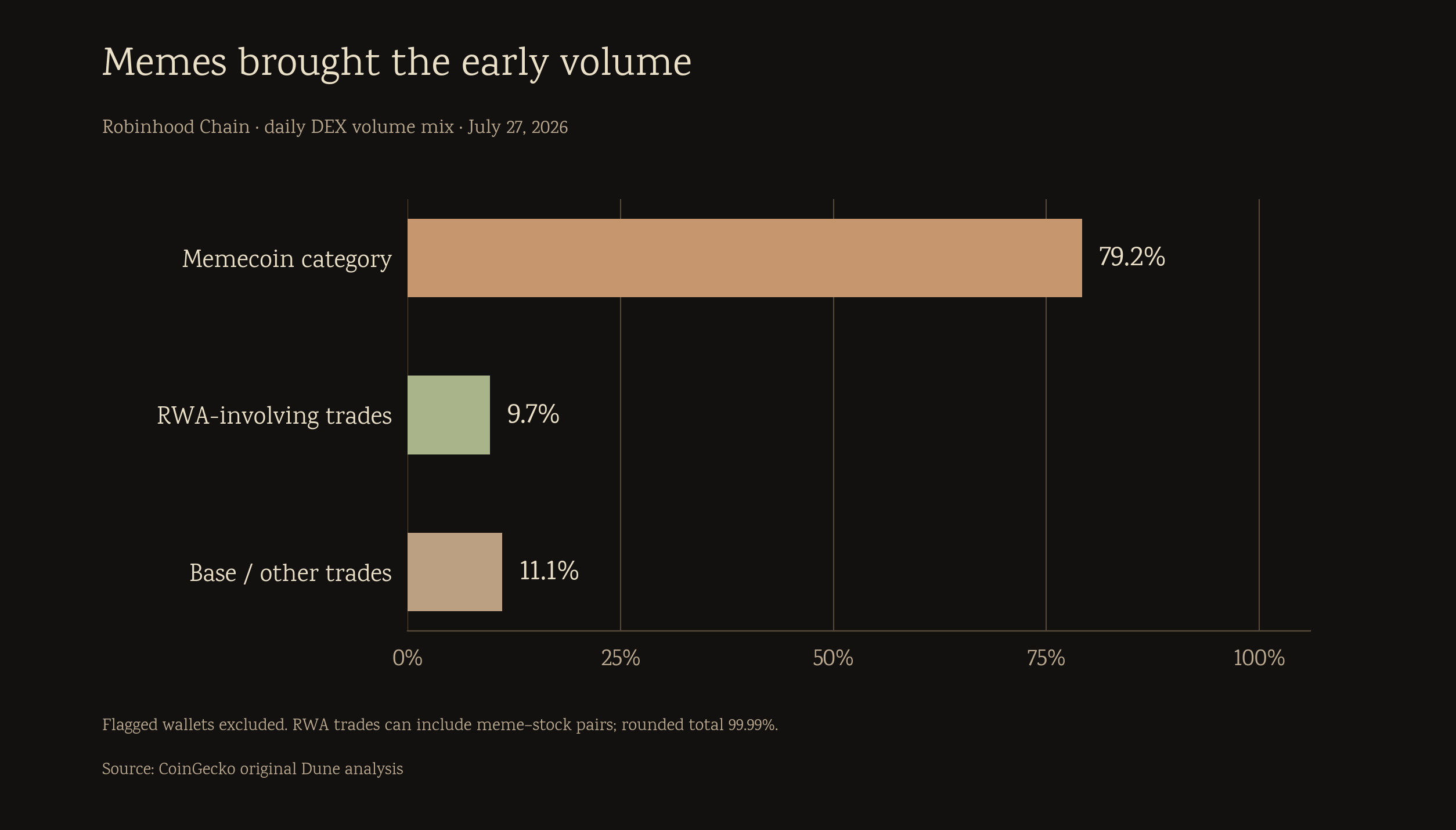
There is nothing particularly surprising about that. A new market needs something people want to trade immediately. Speculation provides urgency, social distribution and a reason to move money. An ecosystem can benefit from all three without pretending every new ticker is a useful business.
The competition also moved quickly. Noxa’s early lead gave way to Pons, which captured 37.2% of launches in the period starting July 13. That is a useful reminder of how little a launchpad’s opening market share says about its permanent position. Creators follow liquidity and distribution; traders follow the next opportunity. [1]
The more consequential question is what survives those movements. Better routing, deeper pools and working wallet integrations can remain useful when a particular coin loses attention. An ecosystem that learns to recycle those improvements has a stronger case than one that measures success only through launches.
I would leave memecoins and launchpads room to compete. Waves of speculation can keep bringing people and capital into the chain. The ecosystem team’s job is to help useful applications develop alongside that activity, with somewhere worth going once the trade is over.
PONS made creation a business
Pons makes the launch itself a product: create a token, trade through its initial market, then continue in a Uniswap pool once it graduates. Its v2 design also lets approved pairing assets become the currency of the launch, including tokenized stocks. Buyers, sellers and creators can all transact in that asset. [2]
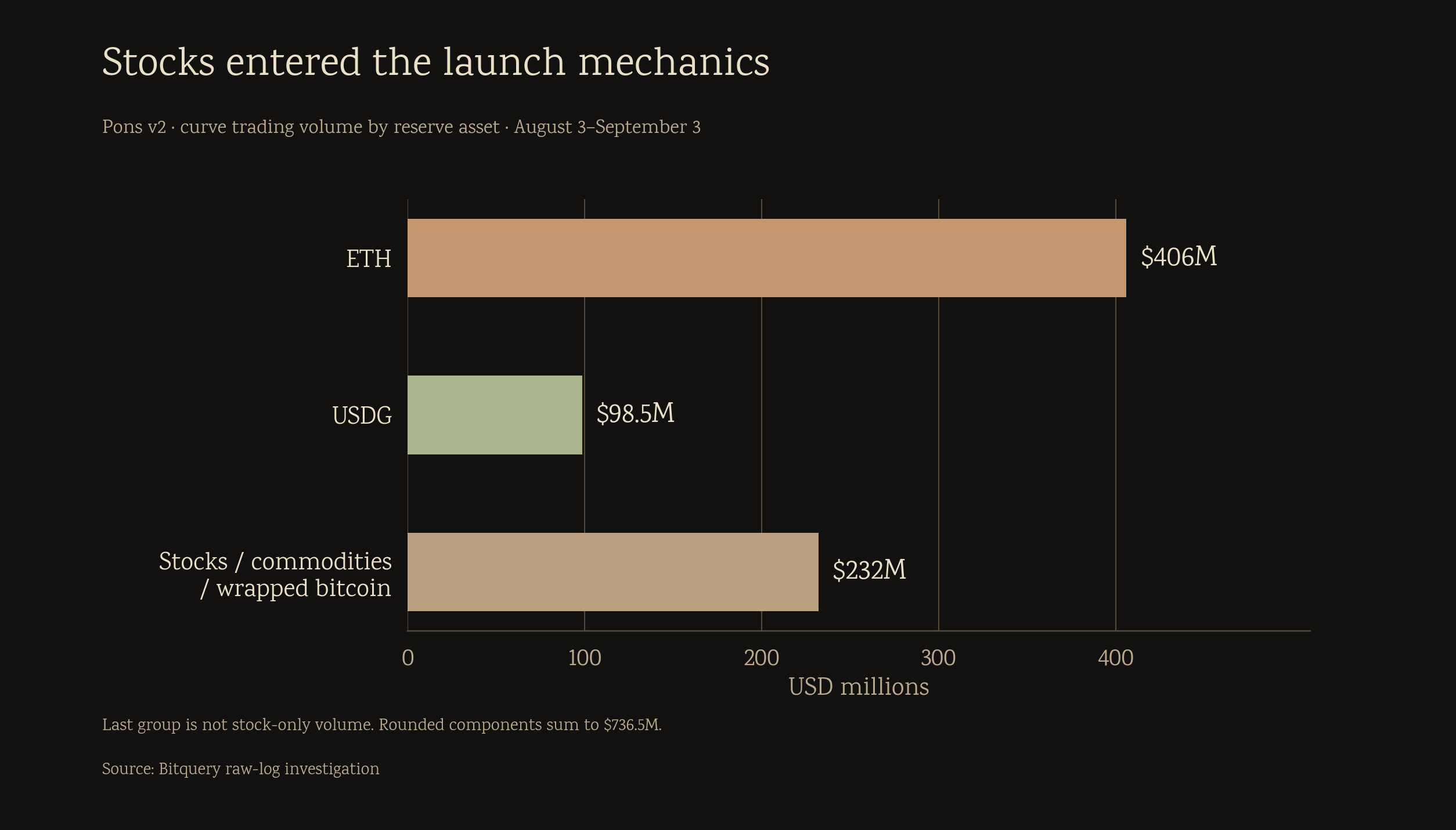
The scale was substantial. Between August 3 and September 3, 207,893 coins were created through the v2 factory. $736 million traded on the curves and $2.14 billion after graduation. Only 3,228 coins graduated, roughly 1.55% of launches. [3]
That combination explains much of the launchpad business. The product makes creation cheap, allows thousands of experiments and collects fees from the activity surrounding them. Economic success for the platform does not require most of those experiments to become valuable tokens. The long tail can generate transactions while a much smaller group attracts the durable liquidity.
It also explains why a large token count is a weak measure of ecosystem quality. 200,000 launches do not represent 200,000 teams building products. The relevant development is a functioning market for creation, discovery and trading, with incentives strong enough to keep people using it.
Pons’ historical fee figures make the acceleration visible: approximately $15.5 million in July, $33 million in August and $140.2 million in September. Those are fees under the project’s accounting, including creator charges and swept pool fees. They are not all income retained by Pons, much less profit. [4]
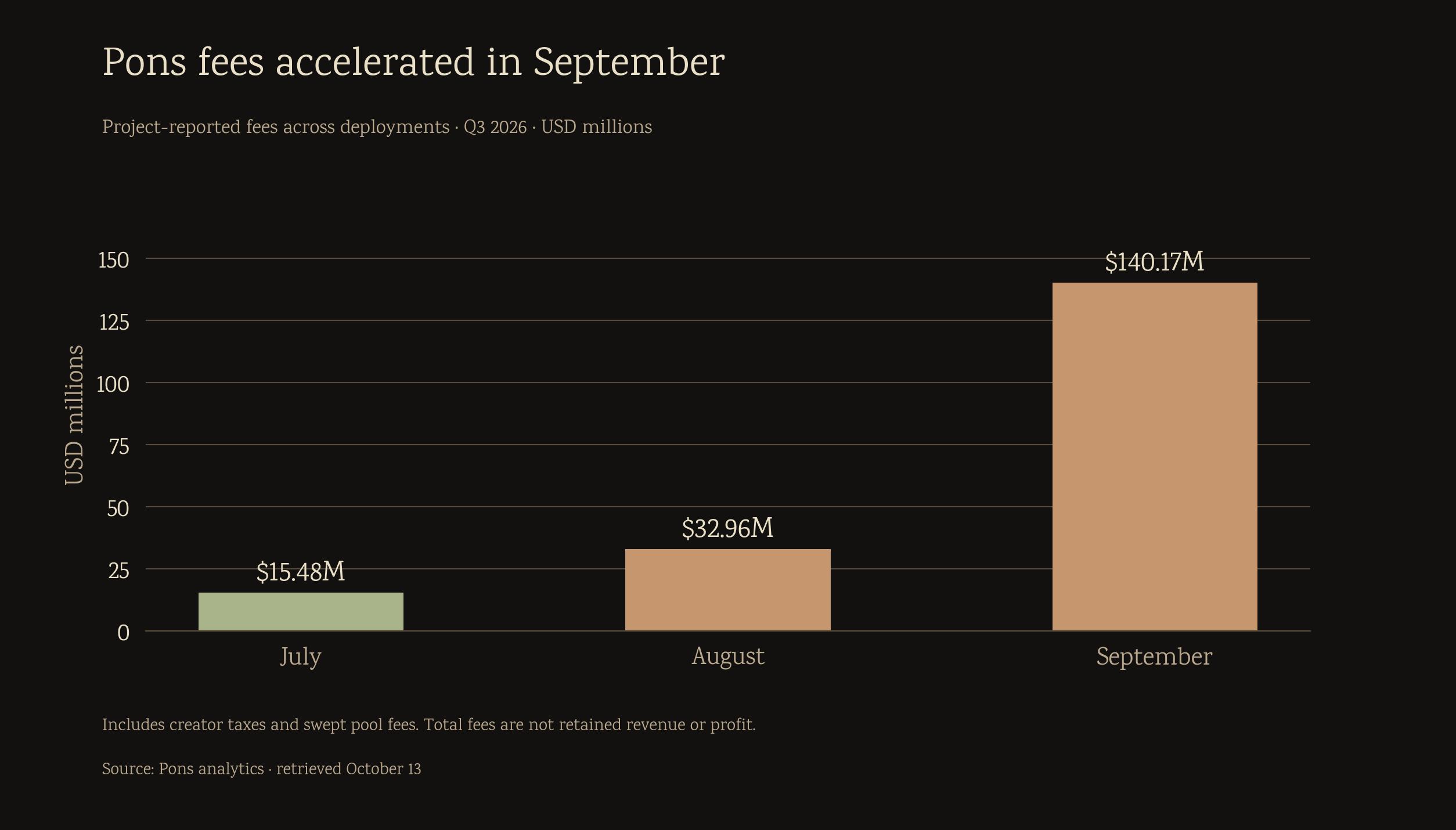
The fee recipient matters because it changes the product’s incentives. A creator earning from trading has a reason to keep attention around a coin. A creator can use that income to keep building around the community. Whether this happens depends on what remains after the initial demand fades.
There is a customer-concentration issue underneath the launch count too. A platform can earn substantial fees from a relatively small group trading repeatedly. That may be a perfectly workable business, but it makes retention of those traders more consequential than the number of people who tried a token once. Creators and active traders need different reasons to return; counting both as adoption hides that distinction.
That is the opportunity for Robinhood: let the launchpad market generate attention, while helping the applications built around its assets develop an advantage that lasts longer than a launch.
Stocks became something to use
The pairing mechanism is where this gets distinctive. A memecoin priced against NVDA requires inventory of the NVDA token. Its pool holds that asset, its traders move through it and its creator can receive fees in it. An equity token acquires a use beyond being a cheaper-looking way to express a stock-market opinion. [2]
In the same August–September Pons study, $232 million of curve volume used tokenized stocks, commodities or wrapped bitcoin as reserve assets. ETH and USDG still carried more activity. But the range of reserves shows that creators were experimenting with the assets this chain gave them, rather than uniformly rebuilding an ETH memecoin market. [3]
Longbow pushes the idea further into product design. Its September 4 LUCKY launch paired a coin with GOOGL. Its Kickback mode routes creator fees to holders; Burner coins route fees into buying and burning the coin. CORN, launched later in September against UNI, provides a concrete example of fees reaching holders in the pairing asset. [5][6]
These are different experiments in what ownership should earn. A holder might be interested in a community, a stream of trading fees or an expected supply reduction. The incentive changes even when the underlying act remains buying a speculative token.
This also changes how to read RWA adoption. Demand for a stock token can come from someone who wants to use it as trading inventory, without wanting a long-term position in the company. That demand is real. Its sensitivity to the memecoin cycle is also real.
Pairing does not make the memecoin safer. A token can rise against its stock pair while falling in dollars if the stock falls enough. The holder now depends on two prices, and the pool depends on the availability of the pairing asset. The same design that creates stock-token demand also imports the stock token’s liquidity and issuer dependencies into the speculative market.
There is a limit to the crossover. On October 13, stock and ETF pairs represented 6.89% of Pons’ trailing-week volume. The mechanism exists, but most of the launchpad’s activity was still elsewhere. It would be premature to treat stock pairing as the dominant reason people use it. [4]
I find the experiment more interesting than the category label. It gives developers a reason to use the assets natively. The important part is whether those uses become large and reliable enough to sustain liquidity after the original attention moves on.
NETNET is trying to make activity fund a balance sheet
NETNET takes a different route. It uses an Olympus-style reserve token, bond subscriptions and staking, with a treasury that can put USDG into lending. Its Real World Bonds desk, live since July 24, directs subscription capital into tokenized equities through Rialto. The resulting positions sit in a separate RWA sleeve, excluded from the backing and NAV calculation. [7]
That last distinction is worth keeping. Holding stocks somewhere in the protocol does not mean NET holders have a direct claim on those stocks, or that the advertised backing includes them. The capital structure determines what the holder actually owns.
NET also charges a 5% levy on buys and sells through mapped pools. The allocation shifts over the first 30 days from four percentage points for management and one for the treasury to the full five for the treasury. A round trip through those pools therefore creates considerable friction. The same feature that accumulates capital can discourage trading. [8]
The model is a useful contrast with a launchpad. Pons monetizes a large number of launches and trades. NETNET tries to use activity to strengthen a reserve system and support additional products. One depends heavily on recurring opportunities to speculate; the other also needs people to accept its fee structure and capital policy.
I would not put NETNET in the same measured-volume category as Pons. There is enough evidence to explain the live mechanism, without an equivalent historical dataset establishing how much chain growth it caused. Its significance here is the experiment: fees and subscriptions becoming capital that can be used elsewhere in the ecosystem.
It also carries a distribution problem. A complex reserve token is harder to explain than buying a memecoin or earning on a dollar balance. Working code is only the beginning. Customers still need to understand the bargain, the exit and why they should keep their capital there.
The useful infrastructure was already doing work
Uniswap supplies pools and execution; Rialto supplies routing and stock-token markets; wallets and aggregators make those markets reachable. These services can benefit from many experiments succeeding without having to pick every winning token themselves.
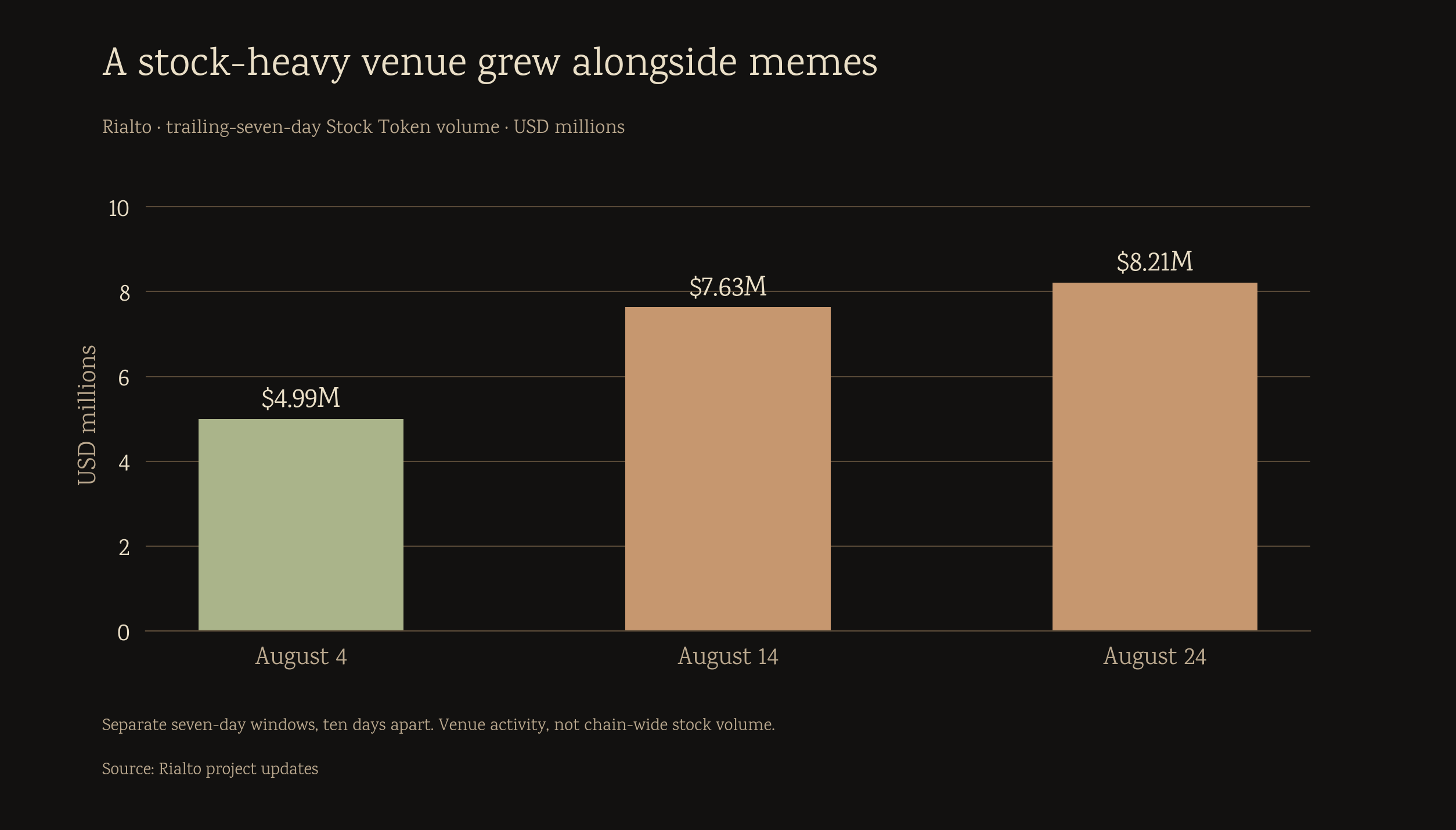
Rialto’s seven-day Stock Token volume grew from $4.99 million at August 4 to $8.21 million at August 24. Stocks accounted for about 78.3% of its $10.48 million total at the latter date. That is evidence of stock-heavy activity at a specific venue, alongside the broader speculative market. [9][10][11]
Varo and Uniswap’s Pools expanded the launchpad options. Rialto’s August 4 update also describes Varo integration into Uniswap’s launch feed, giving creators access to distribution beyond a standalone website. Arcus reported more than $5 billion of combined spot and perpetual volume by October 1, with over 15,000 unique traders. Its retrospective points program complicates any claim that the early activity was entirely incentive-free. [9][12][13][14]
These numbers cannot simply be stacked into an ecosystem total. A Pons coin can trade on Uniswap through a router. The launchpad, exchange and routing interface may all describe parts of the same flow. Their products serve different jobs, but their reported volume can overlap.
That overlap is commercially useful. A builder can inherit execution and distribution instead of recreating both. The risk is that most new apps offer another interface to the same activity, with very little reason for the customer to remain loyal to that particular project.
This is where quality filtering needs to be specific. Does the app improve execution, reduce effort or give the asset another use? Does it own a customer relationship, or merely borrow traffic from the same launch feed? A project can look busy while another interface could replace it tomorrow. Grants and integrations should help teams build an advantage that survives that replacement test.
The quieter product matters too
Robinhood Earn gives the chain a different entry point. Eligible US users can buy USDG and enter a Morpho vault through the main app. There is a familiar customer task underneath it: earn on dollars without assembling the infrastructure yourself. [15]
Earn passed $500 million in deposits during September, while Morpho on Robinhood Chain reached $1 billion in three months. Those scopes overlap, but the scale makes a speculation-only account of the ecosystem incomplete. A financial product had reached users through an existing distribution channel. [16][17]
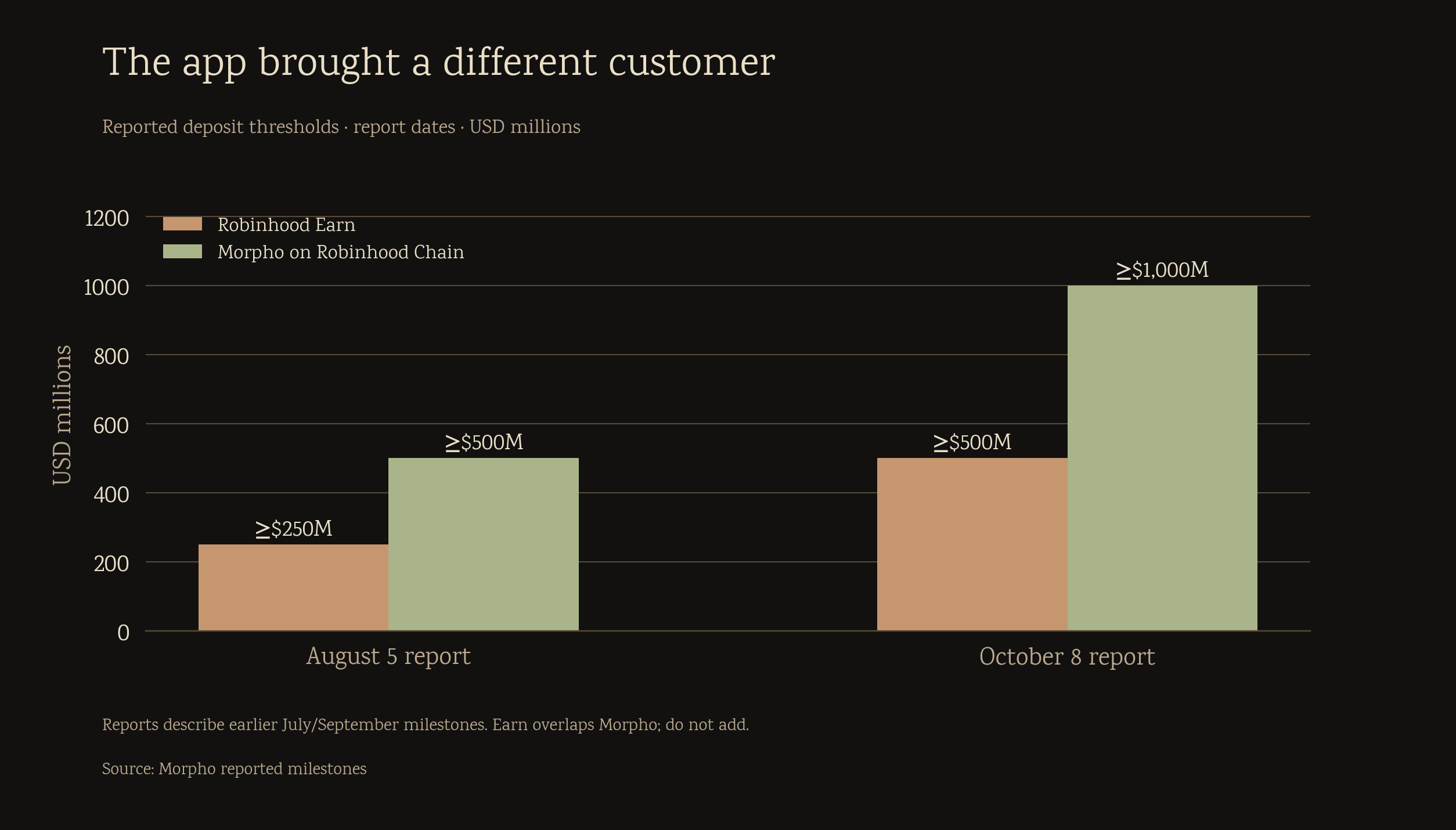
The caveat is economic, rather than technical. Deposits need borrowers willing to pay for them. More capital arriving can reduce returns if borrowing demand does not grow with it. Easy onboarding gives the lending product an advantage; it does not eliminate the need for a workable credit market.
Stablecoin supply reached $1.07 billion at September’s end, up from $102.3 million at launch. Having dollars remain on the chain gives builders something to work with between speculative cycles. Reaching that capital, and persuading its owners to use another product, still requires actual distribution. [18]
Robinhood needs to choose what it is building around
The first quarter brought 793.7 million transactions and $51 million in network fees. Yet 74% of those fees came from just twelve days, August 30 through September 10. The economic pulse was much less evenly distributed than a quarterly total suggests. [18]
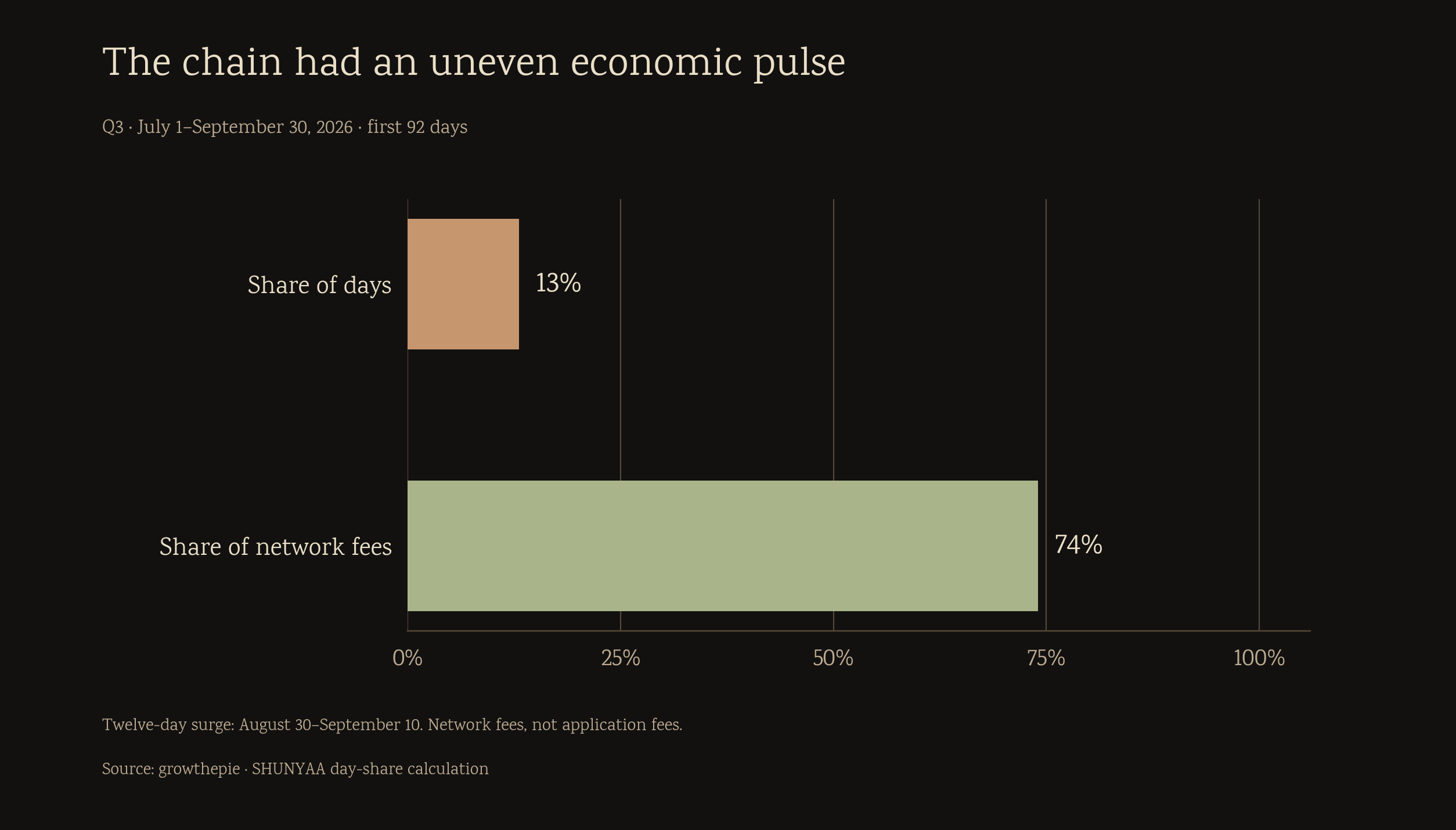
I would take that as a reason to build around cycles, rather than assume the busiest period repeats indefinitely. Memecoin activity can keep returning in waves. The more important work is making sure each wave leaves useful liquidity, better tools and customers who have another reason to stay.
Robinhood has enough distribution to make that possible, but distribution needs a route. Earn has one through the main app. A new stock-token application does not automatically inherit it. Eligibility also matters: these Stock Tokens exclude US persons and other restricted jurisdictions, and give economic exposure without underlying shareholder rights. [19]
An ecosystem team should make those routes concrete. Grants should support products that use the chain’s assets in a distinctive way, followed by help with integrations, liquidity and discovery. A funded application that cannot reach the relevant customer has not solved its growth problem.
London’s Founder House produced a pipeline that included Saffron, Agama Finance and AlphaGrid. Those projects were at different stages; an award is a starting point for support, rather than evidence of a successful business. The useful measure is what gets shipped and used after the programme. [20]
I would be selective about the next batch. Another exchange interface needs an advantage in execution or distribution. Another yield product needs a better reason for capital to stay. Another stock-token app needs to make something possible that buying the underlying exposure already does not.
And the financial assets come with dependencies. The issuer, custody arrangements and market makers matter alongside the contracts. The chain also has a small institutional validator set and council-controlled upgrades. Those are part of the environment a builder inherits, especially when the product promises customers a reliable exit. [19][21]
My view is that Robinhood’s most interesting identity is already taking shape around the interaction between stocks, speculation and credit. Pons and Longbow put stocks into trading mechanics. NETNET experiments with capital accumulation. Rialto connects markets. Earn brings dollar balances through a familiar app.
Some of these experiments will disappear. That is normal. The avoidable failure would be letting the activity pass without helping the stronger ones become businesses. Robinhood has the assets and a credible path to customers. The next phase needs projects that can turn those advantages into a reason to keep coming back.
Sources
- CoinGecko original Robinhood Chain analysis
- Pons v2 documentation
- Bitquery Pons factory investigation
- Pons analytics
- Longbow LUCKY launch
- Longbow CORN launch
- NETNET protocol prospectus
- NETNET trading-fee schedule
- Rialto August 4 update
- Rialto August 14 update
- Rialto August 24 update
- Uniswap Pools launch
- Arcus Wallet integration
- Arcus points programme
- Morpho powers Robinhood Earn
- Morpho July review
- Morpho September review
- growthepie Q3 report
- Robinhood Stock Token issuer FAQ
- Arbitrum London Founder House results
- Robinhood Chain governance